

Bathroom Lighting Design: How to Layer Light for Function, Flattery and Atmosphere
Ask most homeowners to talk you through their bathroom renovation and they’ll start with tiles, brassware, and the bath they’ve had their eye on for months. Lighting, more often than not, gets left until the end. It’s a shame, because lighting is arguably the single most powerful tool you have for shaping how a bathroom feels at seven in the morning, seven in the evening, and every moment in between.
At Hugo Oliver, we’ve been designing bathrooms across South East London for over 12 years, and one of the first questions we ask during a consultation is how our clients want to use their bathroom. A quick shower before work needs very different light to a long soak on a Sunday evening. A well-lit mirror is a completely different thing to a well-lit room. The good news is that you don’t have to choose between them. The secret is to layer your lighting, combining several different sources so that your bathroom can shift in mood and function throughout the day.
Why bathroom lighting deserves more thought than you might think
Bathrooms are small, high-use rooms full of reflective surfaces. Tiles, mirrors, glass screens, chrome taps, and polished basins all bounce light around in ways that can work brilliantly or go badly wrong. A single harsh ceiling pendant will cast unflattering shadows under your eyes at the mirror, make a small bathroom feel clinical, and leave the corners of the room feeling gloomy. Get the layering right, and the same space can feel bright and energising in the morning and soft and restorative at night.
There’s also a practical side. Bathroom lighting has to meet UK electrical safety regulations, with specific IP (ingress protection) ratings required for fittings in different zones around the bath and shower. This isn’t something to guess at, and it’s one of the reasons we always recommend working with a qualified electrician as part of any bathroom project.
The three layers every bathroom should have
Good lighting design, whether in a bathroom, a kitchen, or a living room, comes down to three layers working together. Think of them as the foundations of any scheme.
1. Ambient lighting: your base layer
Ambient lighting is the general, overall light in the room. It’s what you switch on when you walk in and what makes the space usable as a whole. In bathrooms, this usually takes the form of recessed ceiling spotlights arranged in a grid, a central flush or semi-flush fitting, or, in period properties with the ceiling height for it, a statement pendant.
The key with ambient lighting is even coverage. Spotlights should be spaced so that you don’t have obvious pools of light and shadow, and they should be warm white (typically around 2700 to 3000 Kelvin) rather than the cool, blueish light you’d find in an office. A warm colour temperature makes skin tones look healthier and the room feel more inviting.
2. Task lighting: light where you actually need it
Task lighting is the layer most people get wrong. The classic mistake is to rely on a single ceiling light above the basin, which throws your face into shadow exactly when you need to see it most, whether you’re shaving, applying makeup, or checking your skin.
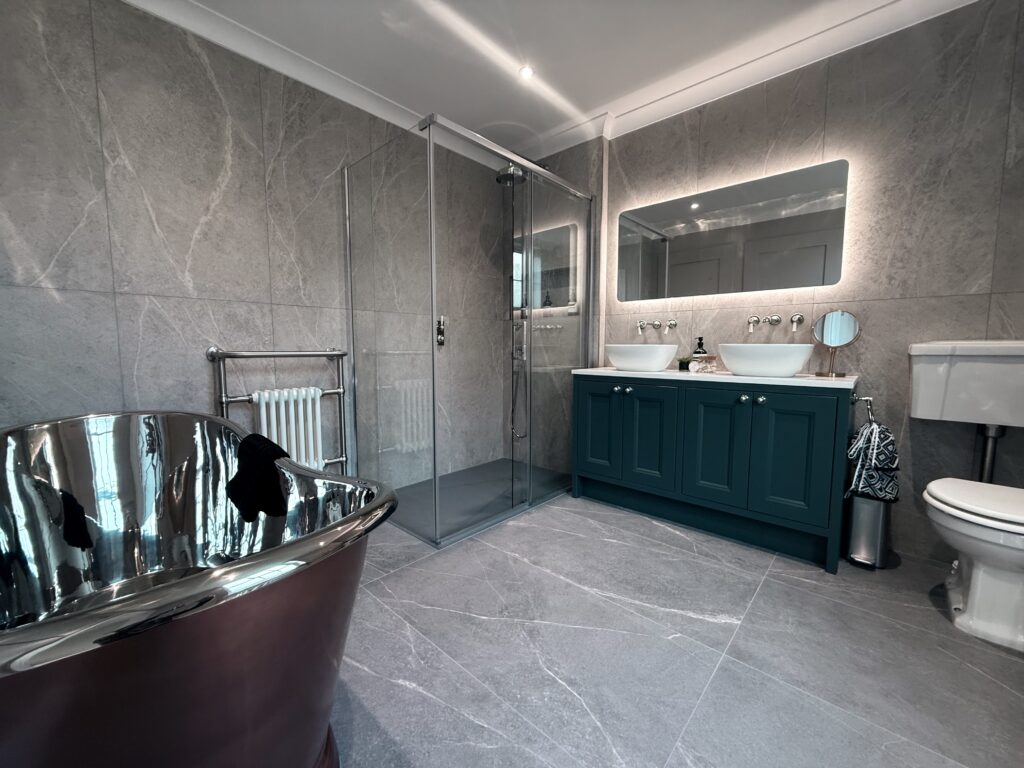
The answer is to light the face from both sides. Wall lights either side of the mirror at roughly eye level, or a well-designed illuminated mirror with integrated LEDs, will give you even, shadow-free light. A lit mirror cabinet is a particularly elegant solution, because you get task lighting and storage in one piece, which is a real advantage in a small bathroom where every centimetre matters.
The shower is the other area that benefits from its own dedicated task light. A single IP-rated downlight directly above the shower keeps it safe, functional, and bright enough to see what you’re doing.
3. Accent and mood lighting: the difference between a bathroom and a retreat
This is the layer that turns a well-lit bathroom into a beautiful one. Accent lighting picks out architectural features, textured tiles, or a favourite piece of brassware. Mood lighting gives you the softer, low-level glow that turns an evening bath into something closer to a spa experience.
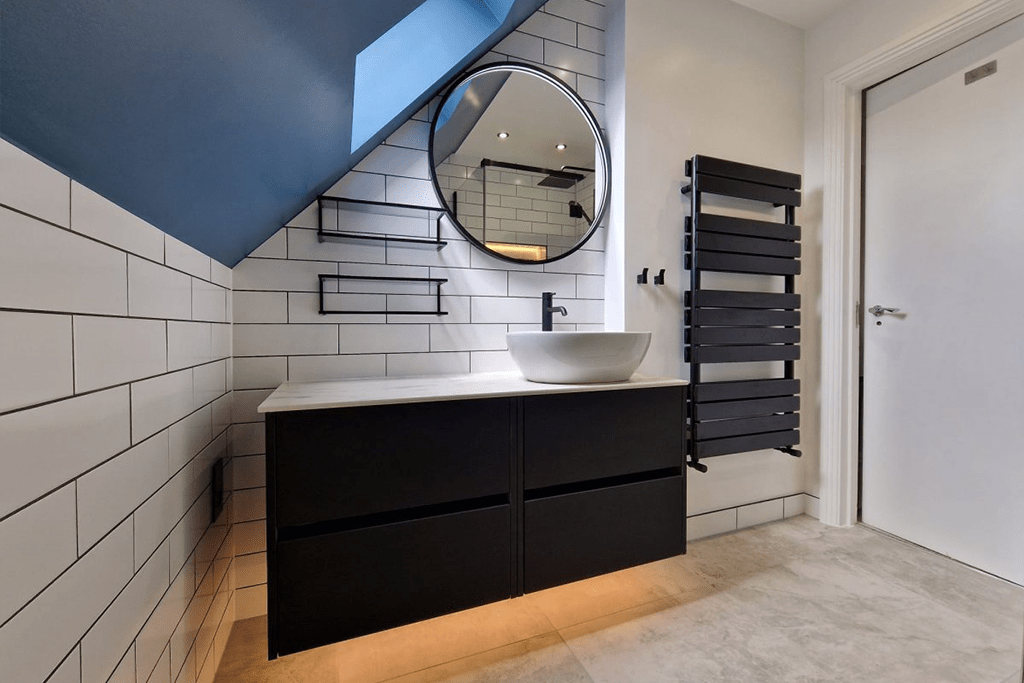
LED strips tucked underneath a floating vanity, behind a mirror, or into a tiled recess are a favourite of ours. They wash soft light onto surfaces, highlight the craftsmanship of your tiling, and, when dimmed right down, can act as a gentle night light. A freestanding floor lamp (in a location outside the wet zones) can bring a surprisingly luxurious quality to a larger family bathroom or master en-suite.

Matching your lighting to your bathroom style
Lighting isn’t a one-size-fits-all decision, and the right fittings will depend enormously on the style of bathroom you’re creating.
In a modern bathroom, we tend to favour clean, minimal recessed spotlights, LED strip lighting built into joinery, and slim illuminated mirrors. The aim is light that feels almost architectural, where you notice the effect rather than the fitting.
A traditional bathroom can carry far more decorative fittings. Crystal or chrome wall sconces either side of the mirror, a glass pendant or small chandelier, and polished brass detailing all help reinforce the classic feel. In Victorian bathrooms, particularly in our local period properties around Blackheath and Greenwich, period-inspired wall lights with opal glass shades can look beautiful against panelled walls or metro tiles.
An industrial bathroom is the right place for exposed pendants, matte black fittings, and cage-style wall lights, all playing off concrete-effect tiles and dark brassware. For a colourful bathroom, on the other hand, lighting is usually best kept quieter, letting the tiles, wallpaper, or painted joinery do the talking while recessed spots and a lit mirror handle the practical work.
Small details that make a big difference
Once the main layers are in place, a handful of smaller decisions will take your scheme from good to genuinely considered.
Dimmer switches are non-negotiable for us. Being able to soften your lighting in the evening is what allows the same room to feel bright and practical at 7am and soft and spa-like at 9pm. Make sure the fittings and the driver are specified as dimmable from the outset, as not all LEDs are.
Separate circuits are the other upgrade most people don’t think about until it’s too late. Having your ceiling spots, mirror lights, and accent LEDs on independent switches means you can light only what you need. Nobody wants every light in the room blazing for a midnight trip to the bathroom.
Colour temperature should stay consistent across all your fittings. Mixing warm white spotlights with a cool white mirror light is one of the fastest ways to make a bathroom feel unsettled, even if you can’t quite put your finger on why.
Finally, think about natural light too. If you’re lucky enough to have a window, frosted or privacy-filmed glass lets you keep the light without sacrificing privacy, and a skylight or sun tunnel can transform a windowless en-suite during the day.
Planning your bathroom lighting with Hugo Oliver
Lighting is one of those elements that’s far easier to get right at the design stage than to retrofit afterwards. Cables have to be run, ceiling positions worked out, IP ratings checked against zones, and dimmers and drivers specified. It’s a layer of the project that rewards careful thought.
If you’re planning a bathroom renovation and you’d like to talk through your options, our team would be delighted to help. You’re welcome to visit our Charlton showroom or Blackheath design studio to see a range of lit displays in person, or get in touch to book a design consultation.
Whether you’re after a bright and practical family bathroom, a calm en-suite, or a statement space built around a freestanding bath, we’ll help you build a lighting scheme that works from the first coffee of the day to the last bath of the evening.


